毕业生< 返回列表



文中,Colin老师巧妙地让艾伦·摩尔、莎士比亚、黑塞、康拉德、托尔金、加缪等文学巨匠的声音依次浮现,从曼哈顿博士的宿命沉思到麦克白的虚无独白,从悉达多的觉悟诘问到奥西诺公爵的哀叹,再穿过黑暗之心与末日火山的绝望,最终在加缪笔下西西弗的坚持中抵达一丝光亮。这不仅仅是文学段落的创作,更是一位老师用他最深爱的方式——文学——向一位特别的学生告别、致谢并祝福。
我们在此衷心感谢Colin老师的用心创作与深情表达。正是这样的文字,让我们看到教育不止于知识的传授,更在于灵魂与灵魂之间的共鸣。
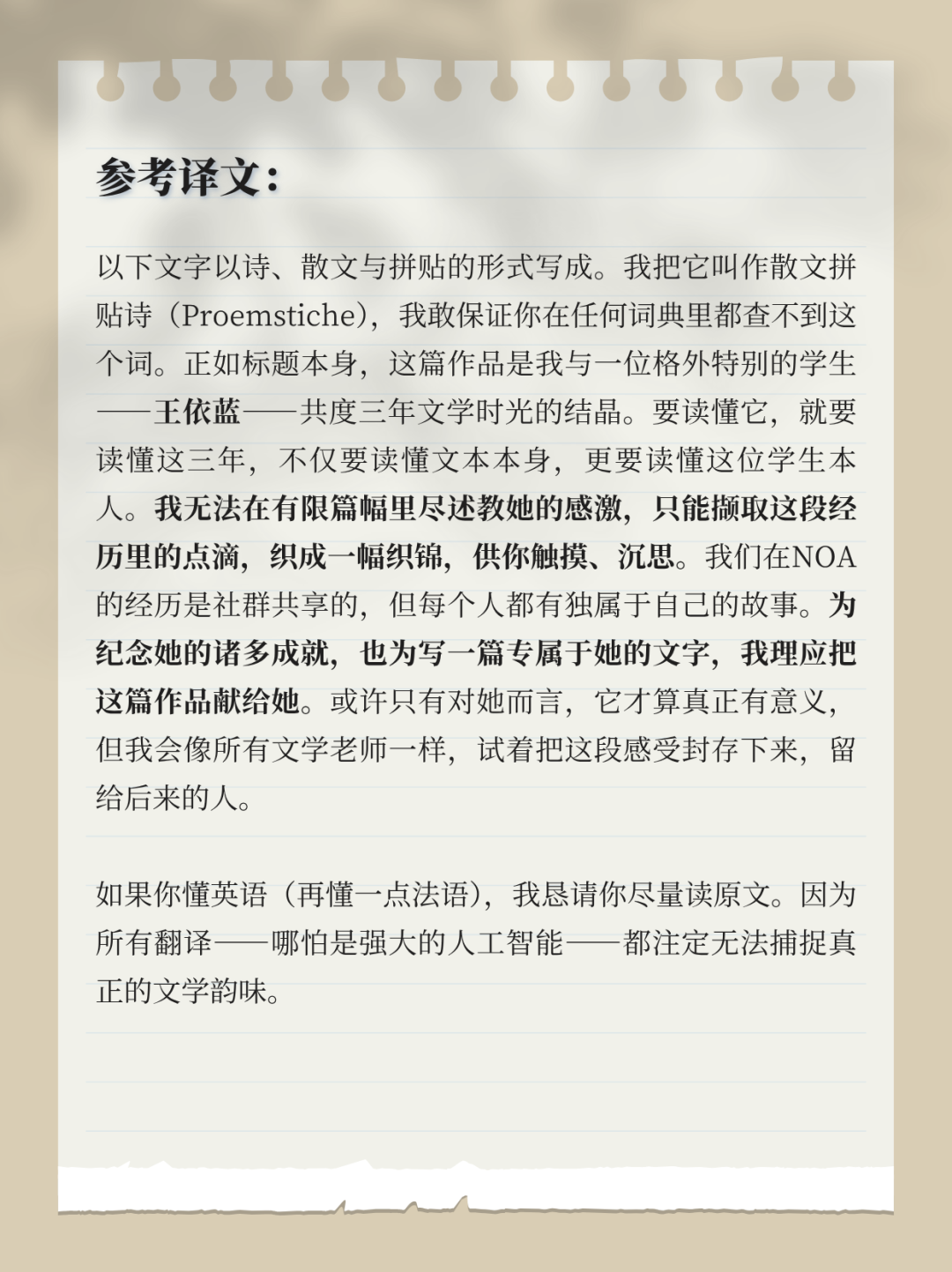
为方便中文读者阅读,下文附上原文的中文翻译。


What follows is something in the form of a poem, prose, pastiche. I’m calling it a “proemstiche” which I’m sure you won’t find in a translator. Like the title itself, the work is the culmination of three years of literary experiences I’ve shared with a very special student, Wang Yilan. To fully understand it would mean to fully understand those three years, including not just the texts themselves, but also the student herself. Since I am unable to express the gratitude I have for teaching her in this limited format, I can only find moments of the experience and stitch together something of a tapestry for you to clutch at and ponder. Although our experiences at NOA are shared as a community, each individual has their own story. I believe that in honor of her many achievements, and by virtue of writing a piece about her, I should write this piece for her. Only to her may it make some semblance of sense, but I will try (as all literature teachers do) to bottle the experience for all others afterward.
If you are familiar with English (and a bit of French), I would implore you to attempt a reading in its original form, as all translations, even with the frightening might of AI, inevitably fail to capture true literary nuance.




By Alan Moore, William Shakespeare, Hermann Hesse, Joseph Conrad, J.R.R. Tolkien, Albert Camus, and last (certainly least), Colin McDonald.

I am ready to begin.
A world grows up around me. Am I shaping it, or do its predetermined contours guide my hand?
In 1945 the bombs are falling on Japan, the cogs are falling in Brooklyn, seeds of the future, sown carelessly.
Without me, things would have been different. If the fat man hadn’t crushed the watch, if I hadn’t left it in the test chamber… am I to blame then? Or the fat man? Or my father, for choosing my career? Which of us is responsible?
Who makes the world?
Perhaps the world is not made. Perhaps nothing is made. Perhaps it simply is, simply has been, will always be there.
A clock without a craftsman.
I am standing on a balcony of pink sand hardened to glass. It glitters in the ten-minute-old sunshine. The light of two hours past will just be reaching Pluto. If they have strong telescopes there, they can see me; the photograph in my hand, falling… lying in the sand at my feet.
I am standing on a fire escape in 1945, reaching out to stop my father, take the cogs and flywheels from him, piece them all together again…
But it’s too late, always has been too late, always will be too late.
Tomorrow, and tomorrow, and tomorrow,
Creeps in this petty pace from day to day
To the last syllable of recorded time,
And all our yesterdays have lighted fools
The way to dusty death. Out, out, brief candle!
Life’s but a walking shadow, a poor player
That struts and frets his hour upon the stage
And then is heard no more: it is a tale
Told by an idiot, full of sound and fury,
Signifying nothing…
nothing to be learned! There is indeed no such thing, so I believe, as what we refer to as ‘learning’. There is, oh my friend, just one knowledge, this is everywhere, this is Atman, this is within me and within you and within every creature. And so I’m starting to believe that this knowledge has no worser enemy than the desire to know it, than learning.”
At this, Govinda stopped on the path, rose his hands, and spoke: “If you, Siddhartha, only would not bother your friend with this kind of talk! Truly, your words stir up fear in my heart. And just consider: what would become of the sanctity of prayer, what of the venerability of the Brahmans’ caste, what of the holiness of the Samanas, if it was as you say, if there was no learning?! What, oh Siddhartha, what would then become of all of this what is holy, what is precious, what is venerable on earth?!”
And Govinda mumbled a verse to himself, a verse from an Upanishad:
He who ponderingly, of a purified spirit, loses himself in the meditation of Atman, unexpressable by words is his blissfulness of his heart.
But Siddhartha remained silent. He thought about the words which Govinda had said to him and thought the words through to their end.
Yes, he thought, standing there with his head low, what would remain of all that which seemed to us to be holy? What remains? What can stand the test? And he shook his head.
Enough; no more;
’Tis not so sweet now as it was before.
O spirit of love, how quick and fresh art thou,
That notwithstanding thy capacity
Receiveth as the sea, nought enters there,
Of what validity and pitch soever,
But falls into abatement and low price
Even in a minute! So full of shapes is fancy,
That it alone is high fantastical.
CURIO.
Will you go hunt, my lord?
DUKE.
What, Curio?
CURIO.
…the heart of darkness. It was very quiet there. At night sometimes the roll of drums behind the curtain of trees would run up the river and remain sustained faintly, as if hovering in the air high over our heads, till the first break of day. Whether it meant war, peace, or prayer we could not tell. The dawns were heralded by the descent of a chill stillness; the wood-cutters slept, their fires burned low; the snapping of a twig would make you start. We were wanderers on a prehistoric earth, on an earth that wore the aspect of an unknown planet. We could have fancied ourselves the first of men taking possession of an accursed inheritance, to be subdued at the cost of profound anguish and of excessive toil. But suddenly, as we struggled round a bend, there would be // the Mountain’s foot on its northern side, and a little to the westward; there its long grey slopes, though broken, were not sheer. Frodo did not speak, and so Sam struggled on as best he could, having no guidance but the will to climb as high as might be before his strength gave out and his will broke. On he toiled, up and up, turning this way and that to lessen the slope, often stumbling forward, and at the last crawling like a snail with a heavy burden on its back. When his will could drive him no further, and his limbs gave way, he stopped and laid his master gently down.
Frodo opened his eyes and drew a breath. It was easier to breathe up here above the reeks that coiled and drifted down below. “Thank you, Sam,” he said in a cracked whisper. “How far is there to go?”
“I don’t know,” said Sam, “because I don’t know where we’re going.”
Je laisse Sisyphe au bas de la montagne! On retrouve toujours son fardeau. Mais Sisyphe enseigne la fidélité supérieure qui nie les dieux et soulève les rochers. Lui aussi juge que tout est bien. Cet univers désormais sans maître ne lui paraît ni stérile ni fertile. Chacun des grains de cette pierre, chaque éclat minéral de cette montagne pleine de nuit, à lui seul, forme un monde. La lutte elle-même vers les sommets suffit à remplir un cœur d'homme. Il faut imaginer Sisyphe heureux.


<< 滑动查看下一张图片 >>


The text opens with Alan Moore’s Dr. Jonathan Osterman (Dr. Manhattan) contemplating his omnipotence and the very nature of time itself. As the only true super-being in Watchmen, Osterman doesn’t just reflect on the past, he experiences it simultaneously with the present during a time in which we as readers witness his creation of a glass castle from the pink sands of Mars. Like graduating students (or anyone) reflecting on their past experiences, they too may wonder if there’s any grand design to it, or perhaps everything exists because of random happenstance: a cold and meaningless universe. As he ruminates on time always having been “too late,” to change things (as if time could ever change), we transition to the voice of the eponymous Macbeth, who delivers one of Shakespeare’s most famous soliloquies at the crux of the drama.
Lady Macbeth has just died, and Macbeth, like Osterman, reflects in nihilistic detail about the slow, meaningless toils of “tomorrow, and tomorrow, and tomorrow…” endless time with no meaning or purpose. He ironically compares life to an actor on a stage- an “idiot” entertaining himself and the universe for just a brief time before inevitable death, having lived a life of no consequence in a universe that doesn’t care. The two figures, of Osterman and Macbeth represent those of us in reflection, contemplating nature of the universe and time, often with cold, grim conclusions. Macbeth’s break in iambic pentameter at the conclusion of the soliloquy’s famous “nothing” is juxtaposed with the sudden hopeful tone of Hermann Hesse’s titular Siddhartha, who believes he has made an exciting discovery on his journey of enlightenment.
Siddhartha explains to his most loyal companion, Govinda, that he believes there might be no such thing as “learning” (at least not in the traditional sense)- that perhaps there is nothing at all but life itself. This is a great blasphemy to Govinda. Siddhartha’s proposed idea frightens his follower, and Govinda responds with fear and incredulous dismay at what this may mean for their most holy institutions and ways of life. How could “nothing” be the answer to everything? Such an idea would overthrow the very culture upon which their whole world has built itself. Taken aback by his most faithful friend’s consternation, Siddhartha questions his foolishness, shakes his head, and while we might expect his voice to say “Enough. No more,” it is the voice of Duke Orsino now speaking.
We are now drawn into the opening monologue of Shakespeare’s Twelfth Night, wherein Duke Orsino, also caught in despair of unrequited love demands that the joyous music playing for him be stopped: “‘tis not so sweet now as it was before.” Orsino continues this thread of those of us who are mired in despair. He appeals to love itself, hopelessly praying for some answer to his loneliness when a well meaning servant, Curio, hopes to distract him with a hunt. In the play Curio’s unwittingly foolish (and somewhat humorous) suggestion of hunting “the hart” (a male deer) is the expected response, but instead we are pulled into quite the opposite atmosphere: Joseph Conrad’s Heart of Darkness.
Here, the narration of Marlow continues to paint a world of wild, primal danger, one in which the true heart of darkness hopes to claim: colonial Europeans. Unknowingly a cog in the great machine of exploitation and death brought to Africa’s dense wilderness, Marlow fears each bend of the river ahead. But around the bend is not the elusive Kurtz, but instead, J.R.R. Tolkein’s most famous monument to corruption and despair: Mt. Doom itself.
Like those of us lost in a dark and alien environment, Sam Gamgee, the ever-loyal, attempts to carry his best friend and the very ring and force of evil up the slopes of Mt. Doom by himself. Two Hobbits, symbolic of the smallest and most humble among us, hope against all the cruelties and most malefic evils of the world that they may somehow find a path up a torturous and wicked mountain, but they collapse, still only partially up the great mountain. Samwise admits he does not know where he’s going, just as many young people thrown into this world may also feel.
And it is there that my “proemstiche” pulls away. The voice of Albert Camus’ philisophical text Le mythe de Sisyphe (The Myth of Sysyphus) preserved in original French makes our conclusion. While this insert may be an absurd challenge to any other English A student, Wang Yilan is more than talented in French, and I know she respects Camus and will appreciate the authentic language of the author more than I’ll ever have any hope of doing. You see, despite all the rumination and despair these literary figures toil with, Camus brings a point of hope to all these struggles. He argues that the mythological Sisyphus, forever condemned to roll a boulder up a mountain only to have it roll back down endlessly, might find some measure of joy in his struggle; it is in the struggle itself that we may find some meaning, however uncaring, uncertain, meaningless, dark, and cruel this vast universe may seem.

What this means to each of us is different, but I know enough of this student and this universe to know that she may have found some hope in these texts, even though she, herself, is off into an unknown, and all-too-often unkind world, as many apprehensive graduates are, too.
She is strong enough and smart enough, as are all of our brave graduates, to overcome it all and make the future a little brighter.


<< 滑动查看下一张图片 >>


END

 微信公众号
 招生部微信